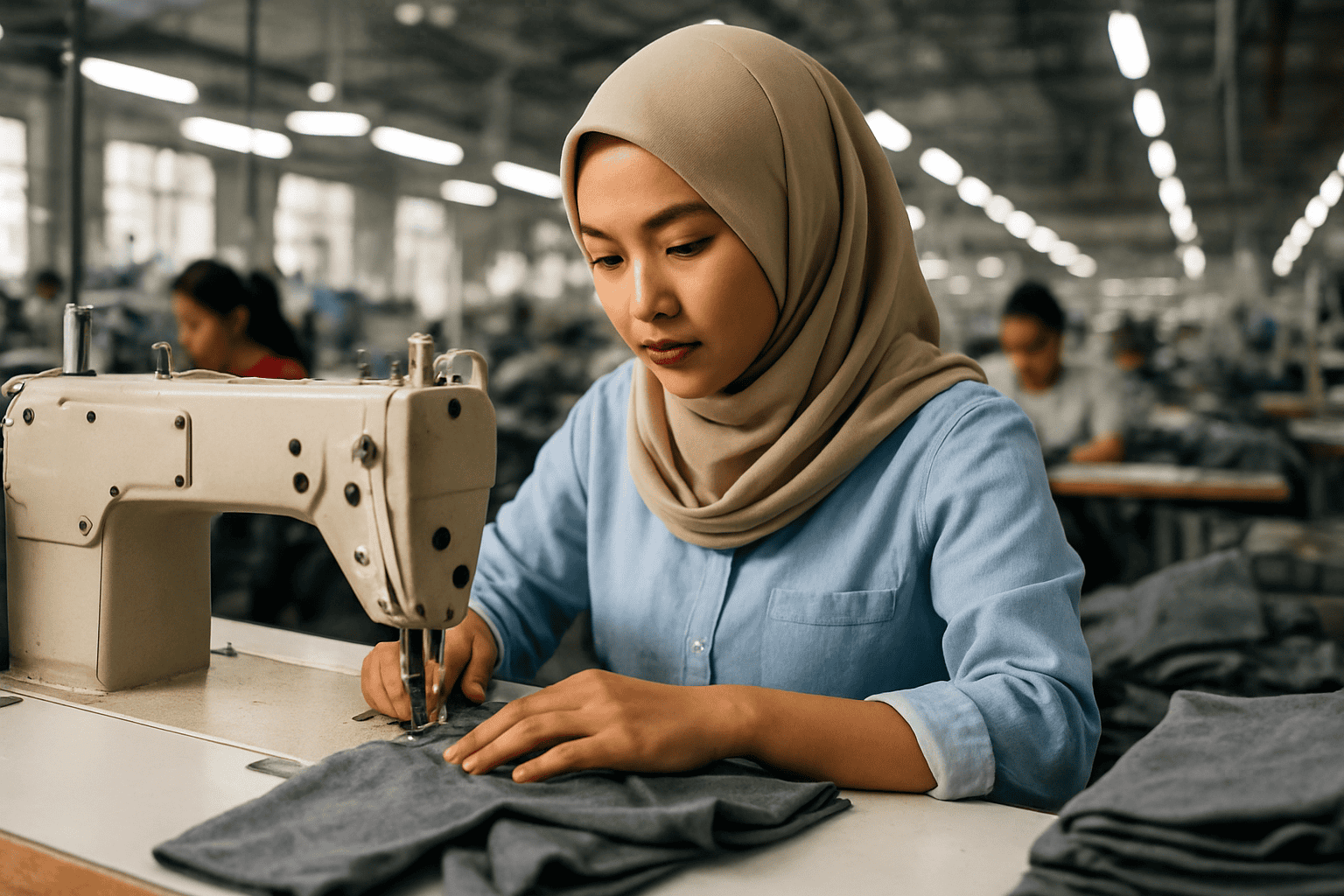
Promotional and corporate apparel lives or dies in the wash, not on the hanger. A branded shirt that survives fifty commercial launderings keeps a logo working for a year; one that curls and fades by wash ten quietly tells everyone the brand cut corners. For buyers running staff programmes, event merchandising or corporate clothing at volume, durability is a manufacturing specification, and this guide covers what to specify, what to check, and how a woven programme from World KNK in Bandung (Indonesia) is built to survive the laundry.
What actually kills promotional apparel?
Three things, in order of how often they are the culprit: fabric chosen too light for the duty cycle, decoration that cannot survive the laundering the garment will actually get, and construction shortcuts at the points of stress. The 2026 buyer guides keep returning to the same evidence; BlankStyle’s September 2026 polo sourcing guide devotes its care section to industrial laundering precisely because branded shirts meet commercial washers, and Essential Workwear’s April 2026 maintenance guide starts from the assumption that logos need protecting inside the machine. Care instructions help, but they are the second line of defence. The first line is the garment being made for the job.
Which fabrics survive repeated laundering?
Fabric choice carries most of the answer. Aura Workwear’s GSM guide for corporate uniforms compares polyester, cotton and poly-cotton blends and matches weight to role, while UniformWeavers’ seven-fabric comparison reaches the practical conclusion: blends hold shape and colour through repeated washing better than pure fibres stretched to their limits. Weight matters as much as blend; the fabric weight guide covers how GSM maps to the job a garment does, and a uniform worn five days a week needs a heavier, tighter answer than an event giveaway.
Then the construction details that never make the quote but always show up in the wash: taped necks, double-needle hems, bar tacks at stress points, and decoration anchored for laundering rather than just for the photo. In a woven programme these are specification lines, not favours, and they cost little in volume.
Decoration methods that survive commercial laundering
Corporate garments meet industrial washers, and not every decoration survives them. Embroidery anchors thread into the cloth and generally outlasts laundering on wovens; prints vary widely by chemistry, and some adhere beautifully while others crack within ten cycles. Placement matters alongside method: a design across a high-friction point or a seam lives a shorter life than the same artwork set sensibly. The specification should therefore name the decoration method, its wash tolerance and its placement, and the approval sample should go through a home wash cycle or two before bulk is signed off.
Tell the factory the garment’s real duty cycle when ordering. Uniforms washed commercially five days a week, merch worn monthly, event stock worn once: each pulls the decoration and fabric advice in a different direction, and the factory can only spec against what it is told.
Sizing across a workforce
A corporate programme is really a grading exercise: one garment shape delivered faithfully across a size run, season after season. Grading drift is the classic programme failure, where the medium fits at launch and the mediums in the second batch fit differently. Digital pattern-making is the antidote; our Lectra systems hold the graded nest exactly, which is why the sample a buyer approves is the sample the reorder matches. The spec should also plan the size curve against the actual workforce rather than assuming a standard ratio, because a programme that runs out of the common sizes first has not failed at manufacturing; it has failed at planning.
How should a durability spec be written?
In numbers, on paper. The spec that survives procurement states the fabric composition and weight, the construction standards at neck, hem and stress points, the decoration method and its wash tolerance, and the reference sample those specs point to. Guides like Oasis Uniform’s August 2026 B2B planning guide make the same argument for bulk uniform orders generally: the buyers who specify precisely are the ones whose reorders match. A vague spec does not fail immediately; it fails quietly on the second batch, when nobody can say what changed.
The check that costs nothing: wash the approval sample at home a few times, the way staff actually will, before approving bulk. One week of real laundering is a more honest test than any certificate of fabric performance, and it catches decoration and weight problems while they are still cheap.
What does a durable programme cost?
Durability is mostly a specification decision, not a premium; the cost drivers are the ordinary ones, laid out in what drives garment cost, with fabric weight and construction detail the two levers that matter here. A heavier cloth and taped construction add modestly per piece and multiply the garment’s working life several times, which is why the cheapest shirt per unit is rarely the cheapest per wear. The benchmark ranges in our cost per piece guide are the honest starting point for that arithmetic.
Programmes run at World KNK from 1,000 pieces per style on FOB terms, with the full process from sampling to packed cartons; smaller brands and mixed promo ranges run the same play through our sister company Kizen Lab, whose guide to promotional apparel that lasts covers the small-volume version of this same specification.
Durability questions from buyers
Which fabric should a corporate uniform programme specify?
A poly-cotton blend in a weight matched to the role, per the 2026 GSM and fabric comparisons from Aura Workwear and UniformWeavers. Blends survive repeated laundering with shape and colour intact, and the weight should rise with wear frequency.
How should staff wash branded garments?
The practical version from the 2026 care guides: cold or 30-degree washes, inside out to protect decoration, low-heat or air drying. A well-specified garment tolerates imperfect care; a fragile one needs perfect care forever, which never happens at scale.
What quantity suits a promotional or corporate run?
Programmes at World KNK start from 1,000 pieces per style on FOB terms. Corporate orders are usually several styles in workable volumes rather than one style in thousands, and the FOB structure prices each garment completely for comparison.
Why do reorders sometimes not match the first batch?
Because the first batch was made from specs the second batch never saw. Locked digital patterns, named fabrics and a reference sample make reorders match; without them, every batch is a fresh negotiation with the past.
Can a programme mix garment types?
Yes, and most do: shirts, trousers and outerwear in one programme, each style at its own volume from 1,000 pieces per style on FOB terms, sharing one production calendar and one specification standard so everything arrives matching.
There is a brand argument hiding inside the durability case too. Corporate apparel is the uniform a company shows the world daily, and a shirt that has kept its shape and colour after fifty washes says something about the business behind it that no slogan on the chest can. Specifying for the wash is specifying for the brand.
Related Articles
- Custom Uniform Programs: A 2027 Guide for Brands
- Fabric Weight and Drape: Choosing the Right Fabric
- What Drives Garment Cost? A Factory’s Honest Breakdown
- Promotional Apparel That Survives Real Washing (Kizen Lab)
- Corporate & Office Uniform Manufacturing in Indonesia
- Government Field Crew Uniforms: Works & Inspection Teams
- Sports Club & Clubhouse Uniforms from 1,000 Pieces
- Caravan Dealer Group Uniforms from 1,000 Pieces