Last updated: 29 September 2026
China Plus One keeps showing up in sourcing conversations for 2027, and half the articles make it sound like a breakup letter to China. It is not. The strategy, properly understood, is about adding capacity in a second country while keeping what already works, and Indonesia has become one of the natural additions for apparel. Here is what the strategy actually means, why brands pair it with Indonesian factories, and how a first woven order from World KNK in Bandung (Indonesia) tests the idea without betting the business on it.
What is China Plus One, exactly?
The definition most logistics companies converge on is simple: keep your Chinese production where it works, and add at least one other country alongside it. FedEx describes the strategy as expanding sourcing or manufacturing by adding another country to China rather than instead of it. Averitt’s supply chain writing goes further and notes that most companies implementing the idea retain China as a key supplier, with some extending to a China Plus Two or Plus Three setup. Nobody serious is suggesting a single move day; the strategy is an addition, run in parallel with what already ships.
That distinction matters because the alternative framing, moving production out of China entirely, carries switching costs the Plus One approach avoids. New tooling, new approvals, new communication rhythms, all at once, with no fallback. Adding a lane keeps the fallback. And when a full move becomes the right call, our migration guide walks the execution stage by stage: how to move clothing production from China to Indonesia.
Why add a second country at all?
The honest reasons are about resilience rather than escape. A single-country supply chain inherits every disruption that country has: port congestion, power scheduling, holiday calendars, capacity crunches that push your reorder behind somebody else’s. Guides from Z2Data and Acclime frame the strategy the same way, diversifying manufacturing to spread risk across regions. A second production lane turns those single points of failure into choices: when one line is tight, the other runs.
There is a quieter reason too. Buyers’ own customers increasingly ask where their alternatives are. A brand that can show a second qualified factory in a second country answers the question before it is asked.
Why Indonesia keeps appearing on the Plus One list?
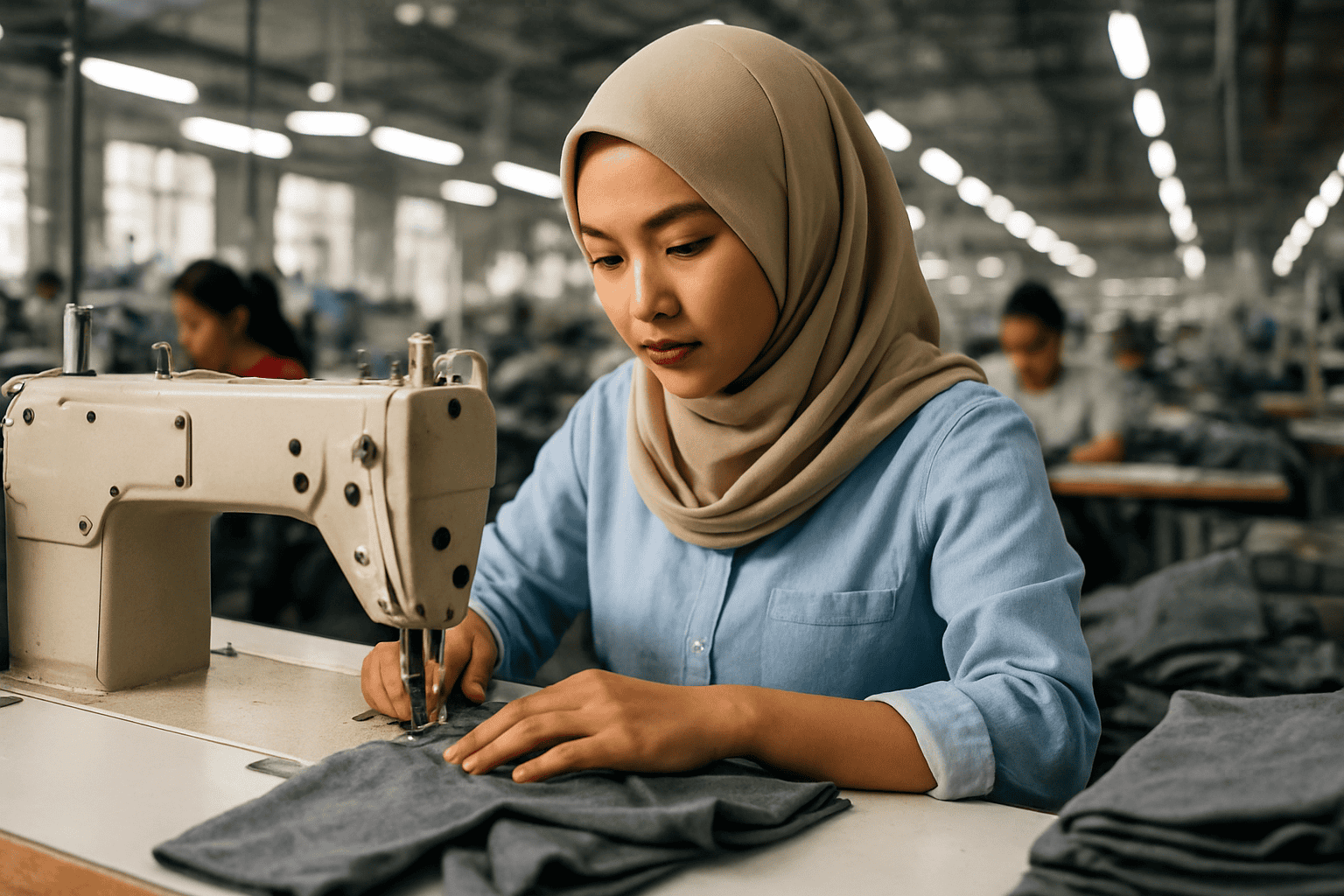
The latest guides name a familiar shortlist. DHL’s SME guide to the strategy points to Thailand, Indonesia and Eastern Europe as diversification destinations, and Eastwise lists India, Vietnam and Indonesia for apparel specifically. Indonesia’s case rests on depth rather than novelty: a large, experienced garment workforce, genuine woven capability at scale, and a supply base that has produced for export brands for decades. Our own floor in Bandung runs Lectra digital pattern-making with structured quality control, part of a group producing around 200,000 pieces a month.
The honest caveats belong in the same paragraph. Indonesia’s strengths are woven garments and disciplined mid-to-large programmes; if a style needs a fabric only Chinese mills hold in stock, that line may stay in China for now. Plus One works when each country keeps what it is genuinely good at.
What does a second lane add that staying put cannot?
Headroom, mostly. A single-source supply chain runs at the mercy of one calendar: one new year slowdown, one port, one queue of reorders ahead of yours. Indonesia’s calendar does not copy China’s; the two production hubs go quiet at different moments of the year, which is precisely the point of pairing them. When one lane hits its seasonal squeeze, the other is usually open, and reorders that would have waited simply move.
The second addition is capacity itself. Our group’s lines produce around 200,000 pieces a month, and a lane with that headroom absorbs a surprise reorder without pushing your next style back a month. Single-source buyers discover whether their factory has headroom exactly when it is too late to matter.
What does the second lane cost to keep?
Less than the season it protects. The upfront spend is a test order and a sample round or two; after that, a qualified second source sits dormant at no cost beyond the relationship, ready the week it is needed. Compare that with the cost of a stalled season: a missed retail window on a proven style usually costs more than the entire test. We walk through the arithmetic style by style in what drives garment cost, and the MOQ breakdown explains why a 1,000-piece entry keeps the insurance premium small.
How does a Plus One test order actually work?
Smaller than most brands expect. A test order with us starts at 1,000 pieces per style on FOB terms: sampling at one to two weeks per round, bulk typically six to twelve weeks, custom fabric development an extra four to eight where the style needs it. The point of a test order is to run the real process end to end, tech pack to packed cartons, on a quantity that proves the lane without a hero commitment. Our pre-production checklist covers what to bring, and the pricing models explained there apply the same as for any programme.
One framing note we give every buyer with sewing already in China: think of us as a diversification lane, not a switch. Keep your incumbent; qualify a second source. If the incumbent is fine, you have lost a sample fee and gained an option. If it stumbles, you are not starting from zero.
Smaller brands run the same play through our sister company Kizen Lab, which produces FOB from 500 pieces across woven and non-woven garments on the same campus standards; the small-brand version of this guide lives on kizenlab.com.
China Plus One questions from buyers
Is China Plus One about leaving China?
No. The strategy adds at least one other country alongside existing Chinese production, and the companies running it hardest mostly keep China as a key supplier, sometimes extending to two or three additional countries.
What quantity proves a new factory?
Enough to run the full process honestly: real patterns, real sampling rounds, real bulk cutting and finishing. At World KNK that means from 1,000 pieces per style on FOB terms, which is large enough to expose how the line actually behaves and small enough to risk on a first run.
Which garments suit a first Indonesian run?
Woven programmes are the core strength here: shirts, trousers, uniforms, outerwear shells. Styles dependent on a specialised Chinese-only fabric stock can stay in China while the rest of the range tests the new lane, which is exactly how Plus One is meant to work.
Does running two countries double the management work?
It adds a second communication rhythm, not a second job. Structured updates, agreed WIP reporting and clear specs make the second lane largely self-running; the common pitfalls guide covers where communication usually breaks and how to prevent it.
Do specs need to change for an Indonesian factory?
No, and that is the quiet benefit: the same tech pack translates. Measurements, grading and construction callouts carry across unchanged, and any fabric substitution a new market suggests gets named and approved at sampling rather than discovered in bulk. The spec you already own is the spec we work to.
Related Articles
- Should You Move Clothing Production Out of China in 2027?
- The Multi-Country Sourcing Playbook: Diversification as a Strategic Imperative
- Why Fashion Brands Are Choosing Indonesia in 2027
- China Plus One: Test Indonesia From 500 Pieces (Kizen Lab)
- Denim Workwear Manufacturing for Construction in Indonesia
- US Uniform Manufacturer from 1,000 Pieces
- Canada Uniform Manufacturer from 1,000 Pieces