
Last updated: 29 September 2026
Ask a sourcing director where their next production move is going and you will rarely hear a single country named. In 2027, the answer is almost always a mix, and Indonesia keeps coming up. Here is what is driving the shift, straight from a factory that lives it every day.
The Numbers Behind Indonesia’s Rise
Indonesia’s textile and garment sector is having a strong year. Industry reports put the country’s textile and garment exports at around USD 4.85 billion in the first half of 2026, with sector output growing more than six per cent year on year. Broader market analysis values Indonesia’s textiles industry at roughly USD 41 billion in 2026, with steady growth projected through the end of the decade. Investment is flowing in too, more than IDR 11 trillion entered the sector in the first half of the year.
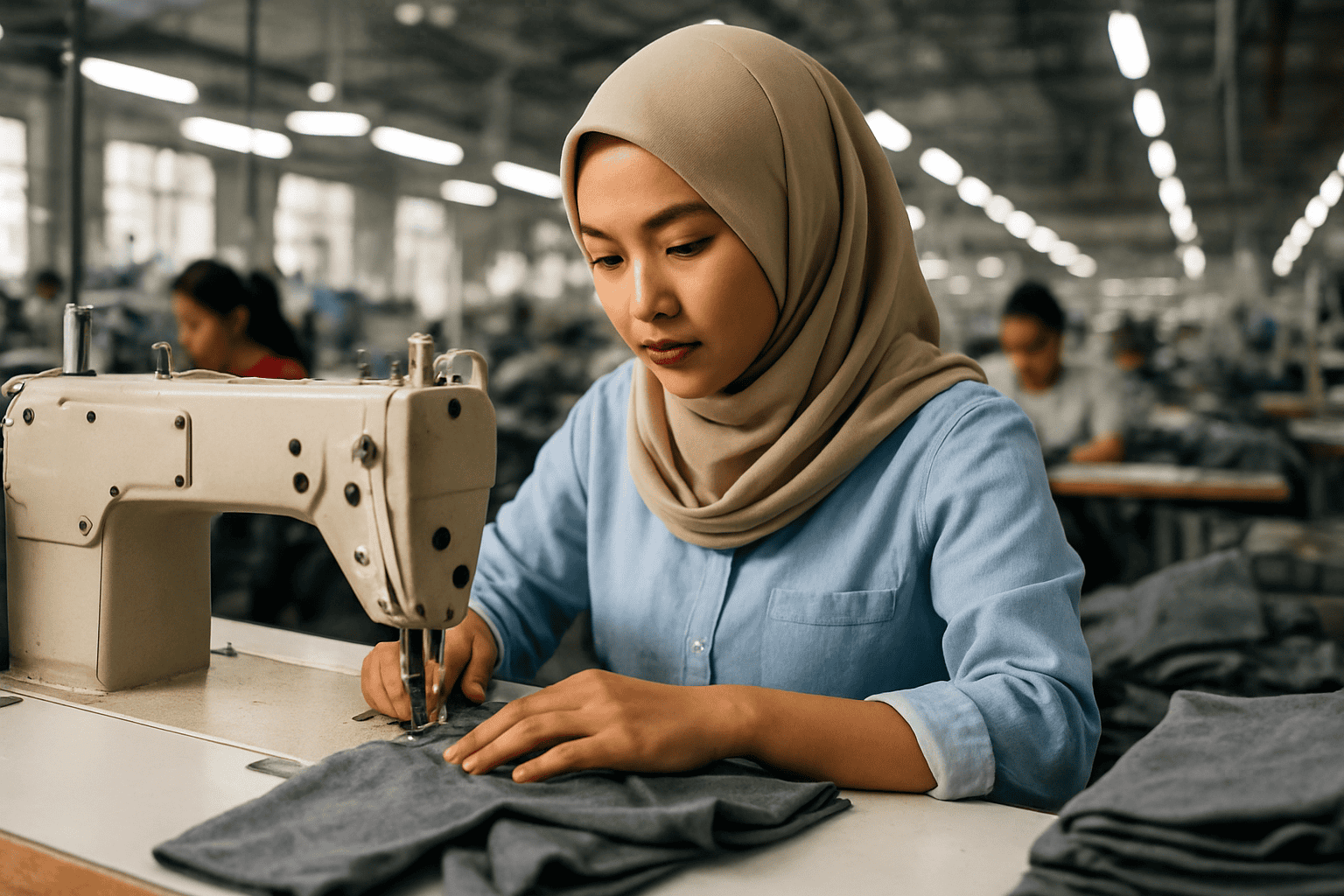
Behind the numbers sit decades of built-up capability: spinning, weaving, dyeing, cutting and sewing at industrial scale, concentrated around Bandung and West Java.
China+1 Is Now the Default, Not the Exception
Industry surveys of US fashion companies in 2026 point to the same lead strategy again and again: diversify sourcing and reduce reliance on any single country. Tariff uncertainty, freight risk and the need for faster replenishment have turned “China plus one” from a boardroom idea into standard practice.
Indonesia benefits because it offers what brands actually need from a second source: real scale, deep garment-making craftsmanship, competitive costs, and a manufacturing culture that handles both large programs and considered, quality-first production.
What Indonesia Does Best
Indonesia’s strengths line up neatly with what fashion and corporate buyers need most: woven garments, shirts, dresses, pants, jackets and uniforms, produced with consistent quality, plus denim, religious and modest fashion, and increasingly technical and non-woven applications. Add competitive pricing against other Asian sourcing hubs and a large, skilled workforce, and the case writes itself.
Choosing the Right Indonesian Partner
A fast-growing industry still requires careful partner selection. Before you commit, ask any factory: What are your real minimums? What is your specialisation? Who controls quality, and how? Can I see samples before bulk? Straight answers to simple questions tell you more than any brochure.
At World KNK, our answers are public: founded in 2000, more than five million garments produced, capacity of 200,000 pieces per month, and a deliberate specialisation in woven garments only, with a minimum of 1,000 pieces per style (1,500 for custom-developed fabrics, because mills set those rules, not us). We design digitally on Lectra systems and run FOB (full service) production: fabric sourcing, pattern, sampling, production and QC under one roof.
Work With a Factory on the Ground
Trends come and go; a dependable production partner does not go out of style. If Indonesia is on your 2027 sourcing map, talk to the factories that are already here. Contact World KNK and let’s talk about your next collection.
Related Articles
- Indonesia as a manufacturing powerhouse: scalability and compliance for American fashion brands
- Advantages of manufacturing in Indonesia for global fashion brands
- Fashion Brands 2027 Clothing Manufacturing Strategy
- Custom Shirts Manufacturing for Fashion Brands
- Dress Manufacturing for Fashion Brands
- Wholesale Uniform Manufacturer for Procurement Houses
- why fashion brands are choosing Indonesia
- Military-Style Clothing Manufacturing for Brands

