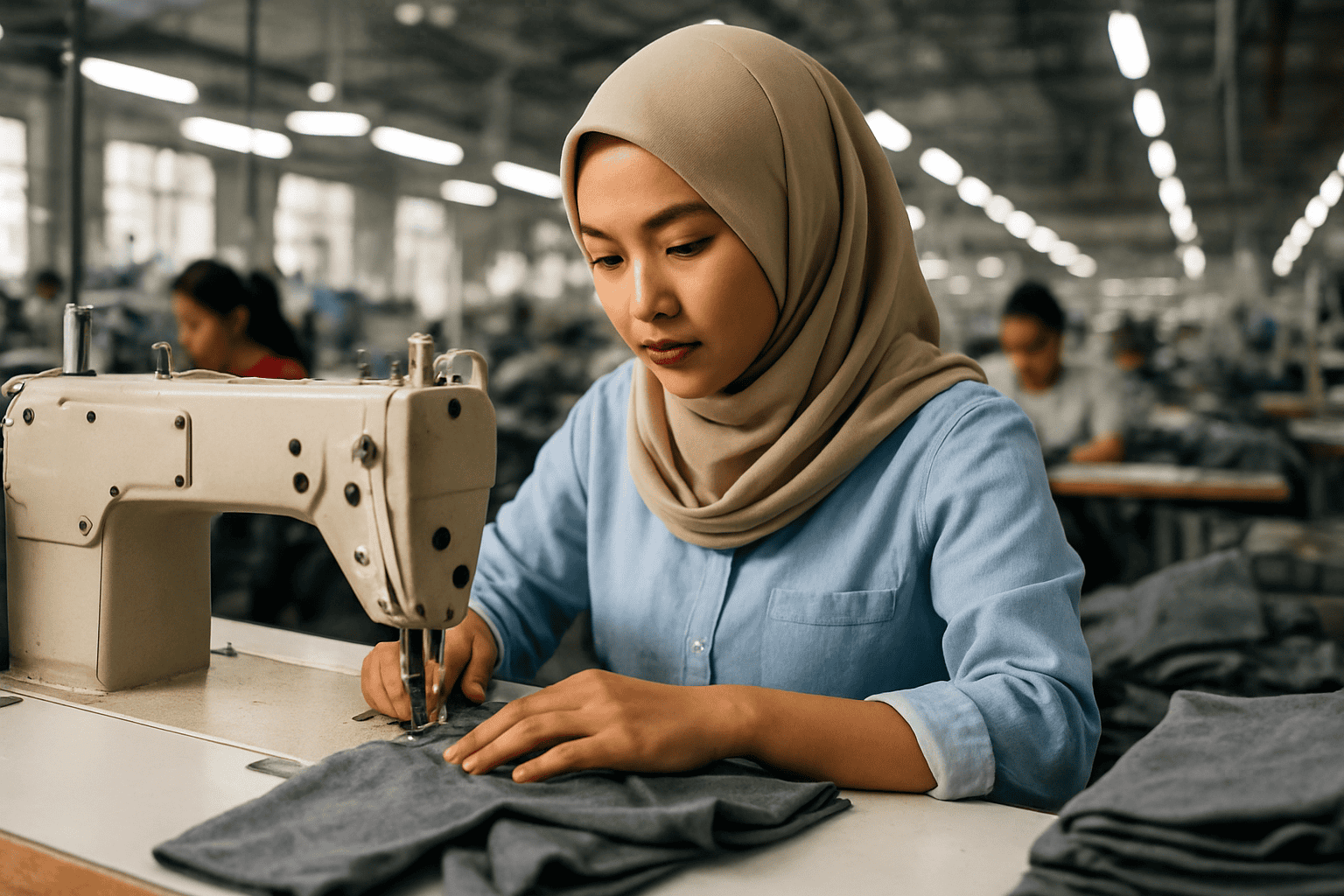
Every garment you have ever worn passed through the same sequence: pattern, cut, sew, finish, pack, ship. What separates a reliable factory from a chaotic one is not the machines. It is how controlled each step is between the cutting room and the carton. Here is what actually happens inside ours in Bandung, in order.
Pattern and marker: before any fabric is touched
Production starts in the pattern room, not the cutting room. Patterns are drafted and graded digitally on Lectra systems, then a marker is planned: the layout that decides how many garment pieces fit into each roll of fabric with the least waste. A poor marker quietly adds cost to every single piece.
Cutting: where accuracy is won or lost
Fabric is relaxed, spread in layers and cut to the marker. Spreaders control tension so plaid lines and stripes stay aligned. Cut pieces are bundled by size and colour with a bundle ticket that follows them through every later stage, so any fault can be traced back to its cut.
Sewing lines: the engine room
Bundles flow to sewing lines balanced by operation: one operator attaches collars, the next joins shoulders, and so on. In-line quality checks happen on the line, not after it. A defect caught at the machine costs minutes. The same defect found at final inspection costs a garment.
Finishing and pressing
Assembled garments are trimmed, pressed and measured against the size chart. Thread ends, spot cleaning, pressing shapes: this is where a garment starts to look like the sample you approved. Colour and measurement checks run here against the approved seal sample.
Packing and the carton
Pieces are tagged, polybagged and packed to the packing list: size ratios, carton marks, carton weight limits. Cartons are labelled for the container plan so that a mixed-container shipment can be unloaded, cleared and distributed without opening every box to find out what is inside.
Documents and dispatch
The final step is paperwork: commercial invoice, packing list, bill of lading, certificates of origin where they apply. Export from Bandung runs through Tanjung Priok or Surabaya, and a well-prepared document set is the difference between a smooth clearance and a container sitting at port.
Why the sequence matters to you
When you ask a factory for lead times, you are really asking how long each of these stages takes under load. Sampling runs one to two weeks, bulk six to twelve depending on fabric. Ask which stages are checked and by whom. A factory that can answer that, stage by stage, is a factory in control of your order.
Related Articles
- Garment Production Lead Times: What to Expect
- Garment Sampling Explained: Why Samples Matter First
- What Drives Garment Cost? A Factory’s Honest Breakdown
- Non-Woven Garments: What They Are and Who Uses Them (Kizen Lab)