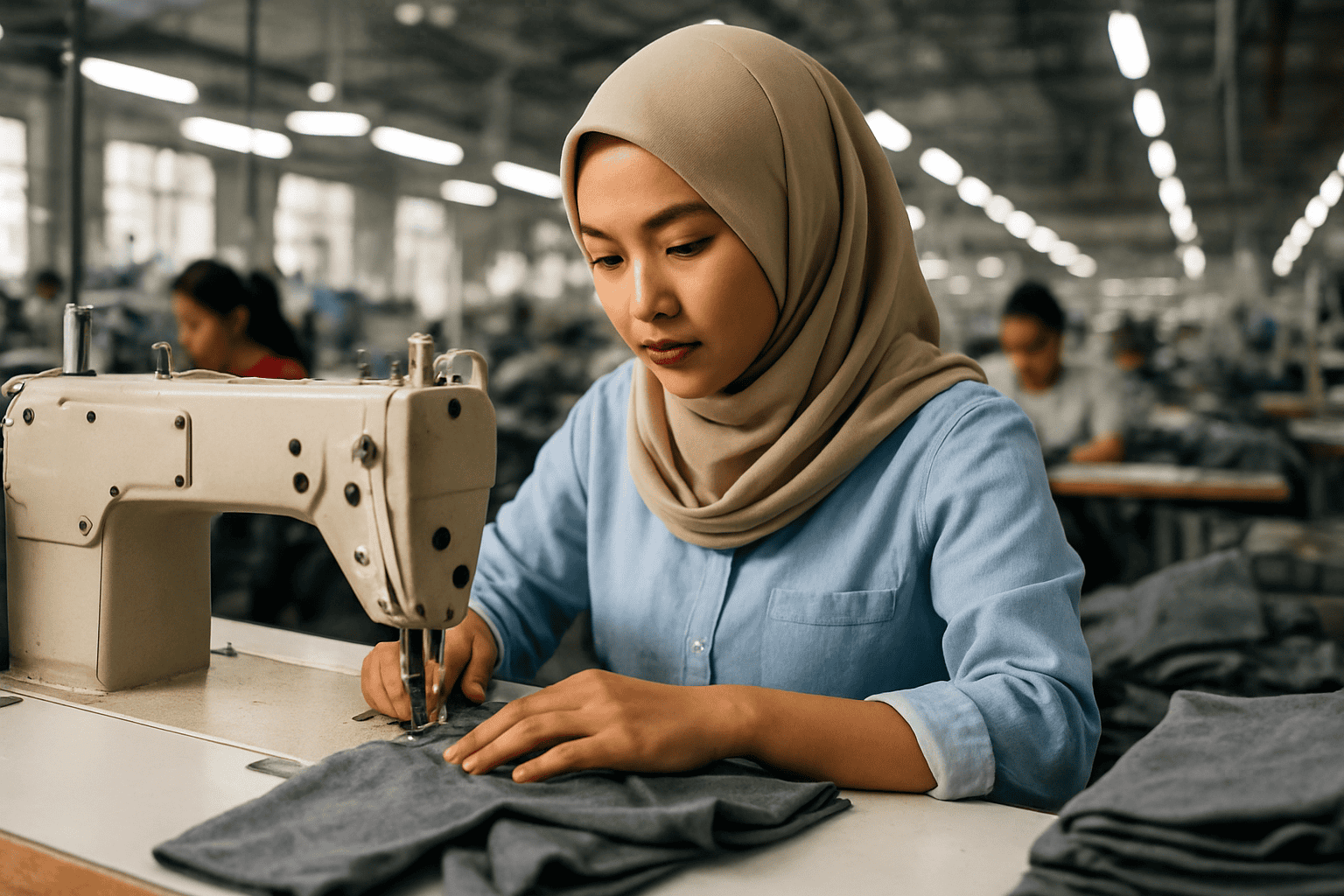
Indonesia vs Vietnam is the comparison behind most country debates in apparel sourcing, and most articles settle it the lazy way: pick a winner, list some wages, done. The honest version is more useful. Vietnam genuinely leads on some measures; Indonesia leads on others; and the decision that actually predicts how your programme goes is made one level below the country, at the factory. Here is the comparison as a manufacturer in Bandung (Indonesia) sees it, warts included.
What does Vietnam do well?
Vietnam’s reputation is earned. Its garment ecosystem is large and deeply specialised, with a workforce that has grown steadily for years and a factory base built around export discipline. Vinmake’s February 2026 analysis ranks it among the best value-for-money manufacturing hubs, citing craftsmanship and rising per-worker efficiency, while noting its labour costs are climbing as that success compounds. For buyers who want a huge vendor market with deep bench strength in almost every category, Vietnam delivers it. Sourcify’s April 2026 comparison adds the counterpart honestly: Indonesia’s factory ecosystem is smaller and less specialised, which means factory selection there simply requires more care.
What does Indonesia do well?
Three things, and they matter more than the smaller vendor list suggests. First, cost position: with Vietnamese labour costs rising, Indonesian pricing on like-for-like programmes is increasingly competitive. Second, a substantial domestic industrial base and local fabric supply, which smooths sourcing for woven programmes in particular. Third, the capacity question nobody asks until it is too late: Vietnam’s best factories are booked far ahead, while established Indonesian factories with real headroom can absorb a new programme when the famous names cannot. Sheng Lu’s sourcing outlook coverage at shenglufashion tracks exactly this reshuffle among second-country suppliers through 2026.
The smaller vendor base deserves its honest spin too. Fewer options mean the screening bar rises, and the factories that clear it, with structured quality control, digital pattern-making and disciplined communication, compete on reliability rather than scale. That is the tier we sit in deliberately.
Which should a clothing brand choose?
The country is the second decision, not the first. The first is the factory, because programmes succeed or fail on communication speed, honesty about problems, and reorder consistency, none of which appear on a country fact sheet. A strong factory in the “wrong” country outperforms a mediocre one in the “right” country every season. Our guide to choosing the right clothing manufacturer covers that screening properly, and the common pitfalls in Indonesian sourcing shows what the care we mentioned actually looks like in practice.
When the country choice does matter, it is usually about fit rather than ranking: category depth, capacity timing, and where a second lane diversifies an existing supply chain. Brands running genuine multi-country setups work this way; the multi-country sourcing playbook describes the pattern.
Where does each country fit a programme?
The practical fit differs more than the rankings admit. Vietnam’s breadth suits buyers who need almost any category at almost any volume, with the trade-off that its best lines are heavily subscribed. Indonesia’s established woven programmes suit buyers who value cutting discipline, structured quality control and reorder consistency, and who want a partner rather than a slot in a queue. Neither is universal: a category with only two excellent vendors in one country and thirty in the other decides itself, which is why the category always comes before the flag.
Which questions actually decide it?
- Capacity timing: who can hold your delivery dates in the quarter you need them, not in theory.
- Category depth: which country has real strength in your specific garment, not adjacent ones.
- Communication fit: who answers within a day, in your working language, with specifics.
- Second-lane value: which country better diversifies the supply chain you already have.
Four questions, answered with real quotes and real dates, and the country debate usually resolves itself. The answers also tell you whether the mature move is one lane or two, and the multi-country pattern linked above is the blueprint once both exist.
What happens after the first run?
This is where the comparison earns its keep, because the first run is the cheapest either country will ever be. A reorder tests whether the sample discipline holds at volume, whether the graded sizes match batch one, and whether the promised six weeks was a promise or a guess. Our own lead time commitments are written to survive that test, and we would rather a buyer check them on a 1,000-piece run than discover them on a container. Whichever country wins your reorder trust, that is the country for your programme.
How would a comparison test actually run?
The same in either country: one style, run end to end. With us that means from 1,000 pieces per style on FOB terms, sampling at one to two weeks per round, bulk typically six to twelve weeks, with custom fabric development adding four to eight weeks when a style needs its own cloth. A single honest run exposes what no comparison article can: how the factory communicates, how the sample translates to bulk, and whether the promised date holds. The benchmark arithmetic in our cost per piece guide sets the budget before you start.
Smaller brands run the identical test through our sister company Kizen Lab, which produces FOB from 500 pieces on the same campus; its small-brand view of this comparison is on kizenlab.com.
Indonesia vs Vietnam questions from buyers
Is Vietnam cheaper than Indonesia for clothing?
Vietnam’s labour costs are rising as its ecosystem matures, and Indonesian pricing on comparable programmes is increasingly competitive. On any real decision, the quotes for your actual styles will answer this better than country averages.
Which country is better for woven garments?
Both produce wovens well; the difference shows up at factory level, in pattern discipline, cutting accuracy and reorder consistency. Indonesia’s established woven factories compete directly on those measures, which is why careful screening matters more there than volume counts.
Can a brand work in both countries at once?
Yes, and that is the mature version of the strategy: qualified lanes in both, each taking the programmes it fits best. The country debate dissolves once the supply chain has two good answers instead of one.
How do I screen an Indonesian factory properly?
Ask about patterns and grading systems, quality control stages, communication rhythms and reorder consistency, then verify with a real production run rather than a courier sample. The screening logic in our choosing guide applies to any country.
The smaller vendor base deserves its honest spin too. Fewer options mean the screening bar rises, and the factories that clear it, with structured quality control, digital pattern-making and disciplined communication, compete on reliability rather than scale. That is the tier we sit in deliberately. West Java also carries generations of textile heritage, and a factory culture where senior machinists and pattern makers are career professionals rather than seasonal hires, which shows up where it counts: in the consistency of the thousandth piece compared with the first.
How do wages compare between the two countries?
Vietnamese wages have been rising with its success, narrowing gaps that used to be wide. The honest answer is that wage headlines matter less than efficiency, fabric costs and factory discipline, which is why per-style quotes decide real decisions and country averages decide arguments.