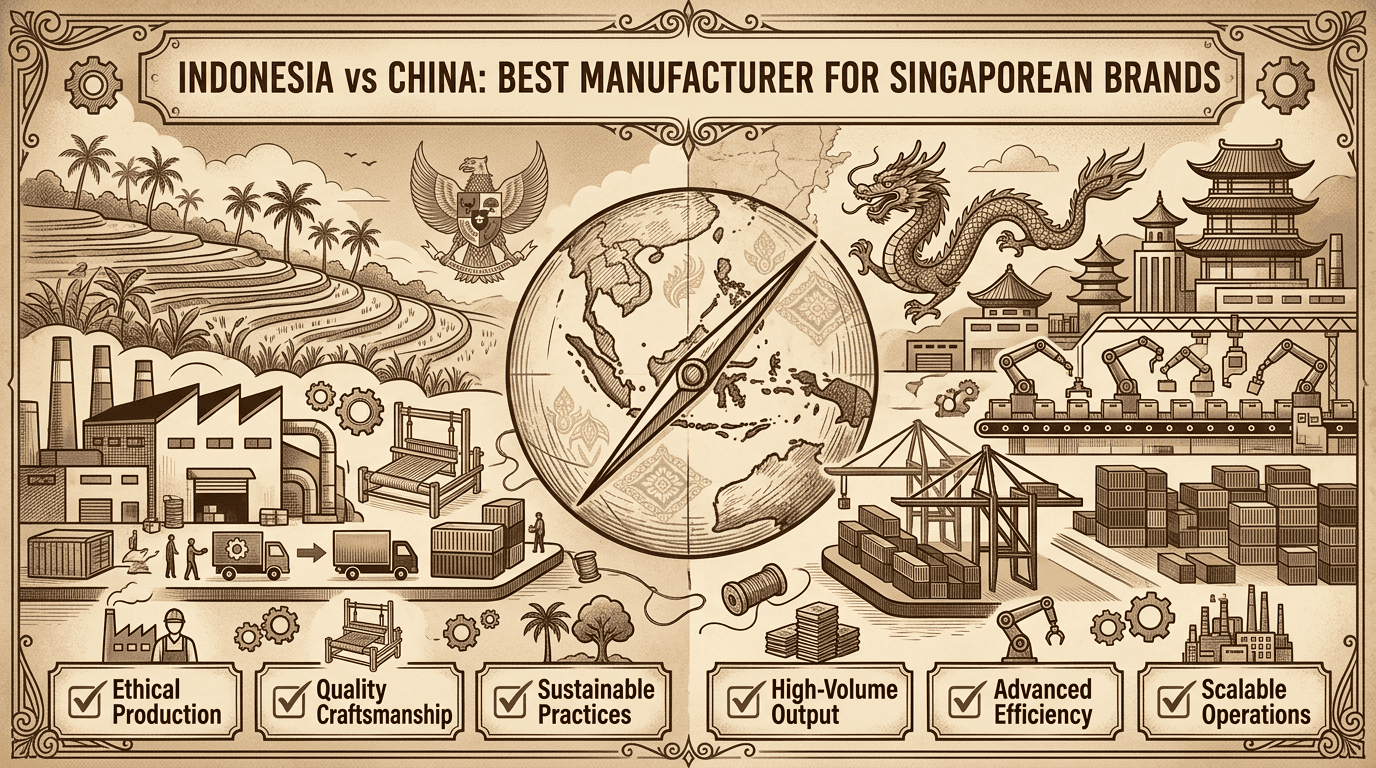
Indonesia vs China | Manufacturer for Singaporean Brands
Singaporean brands are rethinking their manufacturing strategies. With US tariffs on Chinese goods reaching 25-35% and ongoing geopolitical tension, the question isn’t whether to diversify away from China, but where to diversify to. Once you pick the destination, our step-by-step guide to moving clothing production from China to Indonesia walks through tech pack, sampling, budgets and the shipping calendar. For brands selling across Southeast Asia, Australia, and beyond, Indonesia offers the most compelling alternative.
World KNK Clothing Manufacturing has seen this shift firsthand. Over the past three years, we’ve helped dozens of Singaporean fashion brands transition part or all of their production from China to Indonesia. The reasons are straightforward: competitive pricing without the tariff risk, shorter shipping distances, comparable quality for most garment categories, and a manufacturing ecosystem that’s mature enough to handle complexity but flexible enough to welcome new clients.
This guide compares Indonesia and China across the factors that matter most to Singaporean brands, including cost, lead times, product capabilities, trade advantages, and real-world sourcing considerations.
Why Singaporean Brands Are Looking Beyond China
China remains the world’s largest garment exporter at $165 billion annually, but the landscape has shifted. US Section 301 tariffs add 7.5-25% to most Chinese apparel, and the effective rate climbed to roughly 35% by late 2025. Even for brands not selling directly to the US market, these tariffs create supply chain complications when your factory sources components or fabrics from suppliers who are affected.
Rising wages in coastal China now match or exceed those in Turkey, reaching $500-800 per month in major manufacturing hubs. That’s 2-3 times higher than Indonesia’s $200-280 range. The cost advantage that made China dominant in the 1990s and 2000s has largely disappeared for standard garment categories.
Geopolitical risk is harder to quantify but impossible to ignore. Trade policies shift, shipping routes face disruption, and brands with 100% China-based production carry concentration risk that investors and retail partners increasingly flag. Diversification isn’t just smart sourcing anymore. It’s risk management.
For Singaporean brands specifically, Indonesia offers advantages that Vietnam, Bangladesh, and other alternatives can’t match. Geographic proximity means shorter shipping times and easier factory visits. Cultural and business ties between Singapore and Indonesia run deep. ASEAN trade integration provides tariff benefits. Time zone alignment makes communication simpler. These factors add up.
Cost Comparison: Indonesia vs China
Production cost is usually the first question, and the answer depends on what you’re making. For straightforward garments like woven shirts, cotton dresses, uniforms, and casual outerwear, Indonesian factories now offer 15-25% lower per-unit costs than comparable Chinese factories.
Labor cost drives much of that gap. Indonesian garment workers earn $200-280 per month compared to $500-800 in coastal China. That difference flows directly into your FOB price, especially for labor-intensive categories like tailored shirts or garments with detailed finishing.
Fabric costs are roughly comparable. Both countries import much of their fabric from the same sources, primarily China, South Korea, and Taiwan for synthetics, and China, India or Pakistan for cotton. Indonesia does have a domestic textile industry, particularly for basics and some technical fabrics, which can reduce costs and lead times when local fabric is suitable.
Shipping to Singapore takes 3-5 days from Indonesia compared to 7-10 days from China. Shorter transit means lower freight costs per container and less capital tied up in in-transit inventory. For brands running lean inventory models or frequent replenishment, that time and cost saving is significant.
Minimum order quantities (MOQs) are similar. Chinese factories typically require 300-500 units per style per color. Indonesian factories like World KNK work with 500-1,000 units for most categories. If you’re a smaller brand or running limited releases, Indonesia’s slightly higher MOQs are offset by lower per-unit costs and greater willingness to negotiate on initial orders.
Lead Time and Logistics Advantages
Indonesia’s proximity to Singapore creates real operational advantages. Standard lead times from order confirmation to ex-factory are 45-75 days, comparable to China’s 30-45 days for straightforward styles. When you add shipping time, the total timeline from order to warehouse is often shorter via Indonesia.
Factory visits are easier to manage. A Singaporean brand can fly to Jakarta or Bandung in under three hours, spend a day at the factory, and be back in the office the next morning. Compare that to full-day travel to Guangzhou or Shanghai, plus the visa requirements, and the friction of managing Chinese production becomes clear.
Time zone alignment matters more than most brands realise until they’ve experienced the alternative. Indonesia is only an hour behind Singapore. When you need to jump on a call to resolve a sampling issue or approve a production change, working within an hour of your own schedule makes communication faster and simpler.
Supply chain disruptions affect every manufacturing country, but Indonesia’s position within ASEAN and its strong trade relationship with Singapore provide more routing options than single-source dependencies. If a particular port faces congestion, alternatives exist. If fabric supply from one country is delayed, regional options are accessible.
Product Capabilities: What Indonesia Does Best
Indonesia’s garment manufacturing strength centers on sportswear, activewear, outdoor apparel, and woven garments. Major global brands including Nike, Adidas, and Puma source significant volumes from Indonesian factories. The technical capability to handle performance fabrics, bonded seams, waterproof membranes, and multi-layer construction is well established.
World KNK specialises in woven shirts, blouses, dresses, uniforms, religious wear, denim, and outerwear. These categories represent Indonesia’s core competencies. If your product falls into any of these areas, Indonesian manufacturing quality and capability will meet or exceed what you’re getting from China, at a lower cost.
China still leads in ultra-complex technical garments, very high SKU counts with frequent style changes, and product categories that require highly specialised equipment or techniques. China’s supply chain depth means that if you need an unusual zipper, a specific type of reflective trim, or a fabric that only one mill produces, it’s probably available within a few hours of your factory. Indonesia’s supply chain is strong but less dense.
For most Singaporean fashion brands, the product categories where China maintains a clear advantage are narrow. If you’re producing luxury tailored suits, highly technical mountaineering gear, or running 500+ SKUs per season with weekly style updates, China’s ecosystem is hard to replace. For everything else, Indonesian factories deliver comparable results.
Quality Standards and Compliance
Quality is non-negotiable, and the good news is that Indonesia’s garment manufacturing has matured significantly over the past decade. Factories supplying major international sportswear brands maintain quality systems and compliance standards that rival those anywhere in the world.
World KNK operates with quality-first principles. Every stitch matters, and our production processes include multiple inspection points from fabric incoming to final packing. We maintain certifications and regularly host audits from international brands and third-party compliance organizations.
China’s quality reputation is mixed because the manufacturing base is so large and varied. You can find world-class factories in China, and you can find factories that cut corners. The same is true in Indonesia, which is why factory vetting and relationship management matter more than country selection alone.
Ethical production and worker welfare standards in Indonesia are strong, particularly among factories serving export markets. Minimum wage compliance, working hour limits, and factory safety standards are enforced more consistently than in some competing countries. For Singaporean brands that market sustainability or ethical production, Indonesia provides a credible story.
Trade Benefits and Tariff Advantages
Indonesia offers significant trade advantages for Singaporean brands. The ASEAN Trade in Goods Agreement (ATIGA) provides preferential tariff treatment for goods traded between Singapore and Indonesia, reducing costs for brands that import finished goods or components.
The Regional Comprehensive Economic Partnership (RCEP) covers Indonesia, Singapore, China, Australia, Japan, South Korea, and other Asia-Pacific nations. For Singaporean brands selling into Australia, Japan, or South Korea, Indonesian-made garments benefit from reduced tariffs under RCEP, whereas Chinese goods face higher rates in many cases.
For brands selling into the US market, Indonesian garments currently face standard Most Favored Nation (MFN) tariffs, typically 16.5% for apparel. Chinese garments face 25-35% when Section 301 tariffs are applied. That 10-20 percentage point difference erases any remaining cost advantage China might have held and makes Indonesia clearly cheaper on a landed-cost basis for US-bound goods.
EU market access is comparable between the two countries, with both facing standard EU tariffs. Indonesia does not currently have the same preferential EU access as Bangladesh or Cambodia, but neither does China.
Why World KNK Is the Right Indonesia Manufacturing Partner
World KNK Clothing Manufacturing brings over 20 years of garment production experience to Singaporean brands looking for a reliable Indonesia alternative to China. We’re based in Indonesia’s fashion manufacturing hub and specialize in the exact categories most Singaporean brands need: woven shirts, blouses, dresses, uniforms, denim, and outerwear.
Our end-to-end manufacturing model covers premium fabric sourcing, production, quality control, packing, and delivery. You work with one partner through the entire process, not a fragmented network of fabric suppliers, factories, and logistics providers. That integration reduces communication overhead and gives you a single point of accountability.
We deliver on time. Singaporean brands operate on tight schedules, and missed delivery dates cascade through your entire launch calendar. Our production planning and capacity management ensure that agreed timelines are met, whether you’re running a 500-unit test order or a 10,000-unit seasonal release.
Our pricing is competitive with China, our quality is comparable for the categories we specialize in, and we bring supply chain stability without the tariff risk or geopolitical uncertainty that comes with Chinese production. For Singaporean brands ready to diversify, we’re the logical first step.
How to Transition from China to Indonesia
Moving production from one country to another sounds disruptive, but the process is straightforward when you work with an experienced manufacturing partner. Start with one style or a small capsule collection rather than shifting your entire production at once. That approach lets you test factory capabilities, compare quality, and validate costs without putting your main line at risk.
Send us your tech packs, fabric specs, and target pricing. We’ll review feasibility, provide a quote, and produce samples for approval. If quality and cost meet your standards, you move forward with a small production run. Most Singaporean brands we work with start with 500-1,000 units as a trial before scaling up.
Factory visits are easy from Singapore. Fly to Jakarta or Bandung, tour our facility, meet our production team, and see your samples being made. That hands-on verification builds confidence and makes the working relationship feel less like a transactional vendor arrangement and more like a partnership.
Communication is seamless. We operate in your time zone, respond to emails within hours, and handle WhatsApp, video calls, or whatever channel works best for your team. You won’t experience the communication lag or language barriers that sometimes complicate Chinese manufacturing relationships.
Indonesia vs China: Which Is Right for Your Brand?
For most Singaporean fashion brands, Indonesia is now the better choice. You get comparable quality for woven garments, sportswear, dresses, uniforms, and outerwear at 15-25% lower cost. You avoid the tariff risk, geopolitical uncertainty, and rising labor costs that are squeezing margins in Chinese production. You benefit from shorter shipping times, easier factory access, and ASEAN trade integration.
China still makes sense for brands that need ultra-deep supply chains, very high SKU counts, or highly specialized technical garments. But that describes a small minority of Singaporean brands. For everyone else, Indonesia delivers better value, less risk, and a smoother working relationship.
World KNK is ready to help you make that transition. We’ve worked with dozens of Singaporean brands over the past few years, and we understand what you need: reliable quality, on-time delivery, competitive pricing, and a manufacturing partner who communicates clearly and consistently.
Frequently Asked Questions
Is Indonesian garment quality comparable to Chinese quality?
Yes, for most garment categories. Indonesian factories serving international sportswear and fashion brands maintain quality standards that match Chinese factories. World KNK specializes in woven shirts, dresses, uniforms, and outerwear, and our quality control processes ensure consistency across every production run. China’s advantage lies in ultra-specialized or highly technical categories, but for standard fashion and uniform production, Indonesian quality is equivalent.
How much cheaper is Indonesia compared to China?
Indonesian production is typically 15-25% cheaper than Chinese production for comparable garments. Labor costs are 60-65% lower in Indonesia, which translates directly into your FOB price. When you add tariff differences (especially for brands selling into the US), the total landed cost advantage can reach 30-40%.
What are typical MOQs for Indonesian factories?
Most Indonesian garment factories require 500-1,000 units per style per color. World KNK works within that range and can sometimes accommodate lower quantities for initial test orders or for long-term clients. Chinese factories typically require 300-500 units, so Indonesian MOQs are slightly higher but still accessible for small to midsize brands.
How long does shipping take from Indonesia to Singapore?
Shipping from Indonesia to Singapore takes 3-5 days by sea, significantly faster than the 7-10 days from China. That shorter transit time reduces freight costs, gets your products to market faster, and ties up less working capital in in-transit inventory.
Can Indonesian factories handle technical sportswear and activewear?
Yes. Indonesia is one of the top global producers of sportswear and activewear, with major factories supplying Nike, Adidas, and other international brands. Indonesian manufacturers have the equipment and expertise to handle performance fabrics, bonded seams, waterproof membranes, and technical construction. If your product is activewear or outdoor apparel, Indonesia is one of the best options globally.
What trade agreements benefit Singaporean brands sourcing from Indonesia?
The ASEAN Trade in Goods Agreement (ATIGA) provides preferential tariffs for goods traded between Singapore and Indonesia. The Regional Comprehensive Economic Partnership (RCEP) reduces tariffs on Indonesian-made goods sold into Australia, Japan, South Korea, and other member countries. These agreements make Indonesian manufacturing more cost-effective than Chinese alternatives when selling across Asia-Pacific markets.
How do I start working with World KNK?
Tell us your tech packs, fabric specifications, and target order quantities here. We’ll review your requirements, provide a detailed quote, and produce samples for your approval. Most Singaporean brands start with a small test order of 500-1,000 units before scaling up to full seasonal production.

Ready to Make the Switch?
Singaporean brands are moving production to Indonesia, and the results speak for themselves: lower costs, comparable quality, faster shipping, and less risk. World KNK Clothing Manufacturing is your trusted partner for that transition.
With over 20 years of experience, end-to-end manufacturing capabilities, and a quality-first approach, we help fashion brands and organizations scale their production seamlessly. Whether you’re testing Indonesia for the first time or ready to shift significant volume, we’re here to make it work.
Every stitch matters. Let’s build something great together.