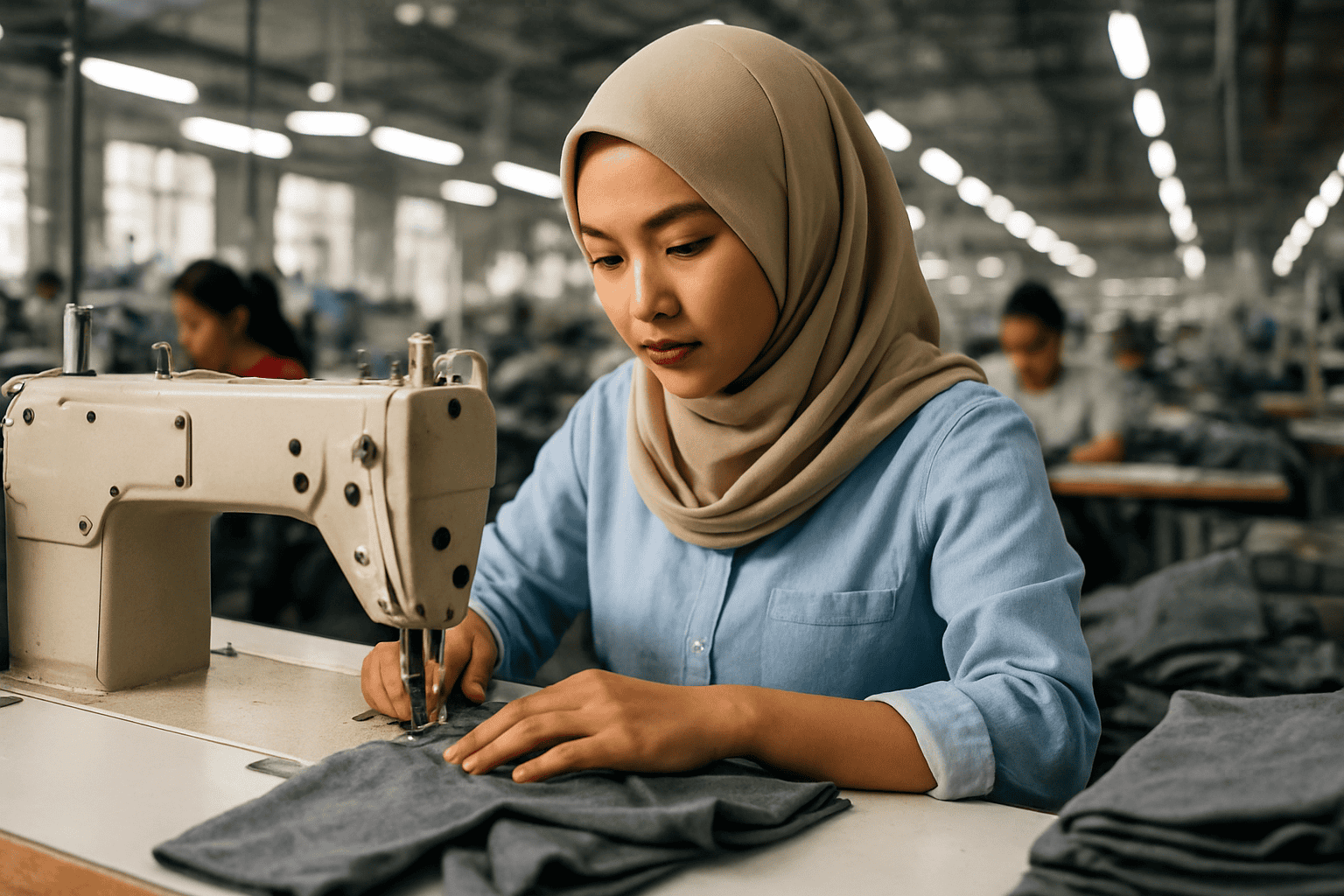
Four fabrics carry most Raya collections: nidha, satin crepe, rayon and twill. The choice of baju kurung fabrics is the first real decision in a kurung or kebaya programme, made at the brief and paid for at the cutting table, and Hari Raya Puasa on Wednesday 10 March 2027 gives every label the same deadline to make it well. This guide compares the four from a cutting floor in Bandung, where Raya 2027 collections are already being scheduled, with orders taken from December 2026 to mid-January 2027.
What is nidha fabric?
Nidha is the modest-wear staple: modest-wear fabric guides describe it as a matte, finely textured crepe of medium weight with a smooth, fluid drape that hangs without clinging and resists creasing (market reference). It is fully opaque, so kurung pieces cut in it need no lining, and it holds a straight line through a long day, which is what a Teluk Belanga or Cekak Musang cut asks of it. On the floor it behaves like a crepe should: stable under the knife, clean at the placket, presses flat at a low heat. For the classic kurung shapes, it is the default answer.
What does satin crepe bring to a festive piece?
Satin crepe is the evening version of the same idea. It is a double-faced cloth, a matte crepe side and a shiny satin face, and fabric guides rate it wrinkle-resistant for the same structural reason. Two things matter at the brief. First, the shimmer shifts with the light, so every piece is cut in a single direction, and the marker is planned one way from the start. Second, care is gentler than for nidha: a hand wash or gentle cycle at low temperature, no tumble dryer. Satin crepe is where the embellished, occasion-end kurung and the modern kebaya live, and the double face gives a festive piece its depth under light.
When does rayon make sense for a Raya piece?
When the collection has to survive the climate. Rayon is airy enough to circulate air in humid heat and more absorbent than cotton, which is why everyday kurung and modest dresses are cut from it across the region (market reference). Two honest caveats belong in the brief. Lighter rayons can be translucent, so the pieces that need it are lined, which is quoted as its own line. And rayon wrinkles more readily than the crepes, so a rayon piece is an everyday piece, not a fifteen-hour wedding piece.
Where does cotton twill fit?
Twill is the everyday answer that asks for nothing. Its dense diagonal weave is effectively opaque without lining, it resists wrinkles and stains, and it holds a pressed edge through March heat, which is why everyday kurung layers are cut from it alongside rayon, and programme shirts beyond the festival too. It is rarely the fabric a customer names first, and often the one she reaches for most.
Which fabric goes with which style?
The mapping is simpler than four fabrics suggest. The classic kurung cuts take nidha, where the drape and the crease resistance do the work the embellishment would otherwise do. Occasion pieces, embellished Moden cuts and modern kebaya, take satin crepe, cut one direction. Everyday and capsule pieces take rayon or twill, lined where the weight asks for it. A collection usually carries two of the four, and the brief that names its two, with lining preferences, is a brief that samples once. The collection-level view of these choices sits on our Hari Raya collection page.
What does the factory need at the fabric decision?
Three inputs. The fabric name per style, from the four above or a comparator. The lining preference per piece, since opacity varies by weight. And the tolerance for development, because stocked cloth starts at the cutting table instead of at the mill, while fabric developed for the programme starts at 1,500 pieces per style, against the 1,000-piece style floor, and its mill weeks land before the first cut; the minimum-order page explains where both floors come from. Up to two colours per style travel with the fabric name, and samples are cut in the chosen cloth, never a substitute. A label trialling one fabric story first can book it on Kizen Lab’s Raya pilot at 500 pieces per style.
Raya fabric questions
Which fabric is best for a baju kurung?
Nidha, for most collections. It is the matte, finely textured crepe the region’s modest wear is built on: opaque without lining, resistant to creasing, and stable through a long day. Satin crepe takes the occasion pieces and rayon or twill the everyday ones.
Does rayon need lining in a kurung?
Lighter rayons can be translucent, so the pieces that need it are lined, quoted as its own line in the programme. Heavier rayons often stand alone. The brief states the preference and the sample confirms it.
How should festive fabrics be cared for?
Nidha machine washes cold and hangs dry. Satin crepe prefers a gentle cycle at low temperature, no tumble dryer, and a low iron from the wrong side. Rayon wrinkles and prefers a delicate wash. The care card follows the fabric at the brief.
When should Raya 2027 fabrics be chosen?
At the brief, between December 2026 and mid-January 2027, because the mill time for developed cloth sits at the front of the programme. All four windows’ order-by dates sit side by side on the factory’s Singapore festive production calendar for 2027, and the buyer-side version of this window runs on our sourcing desk’s Raya order clock.