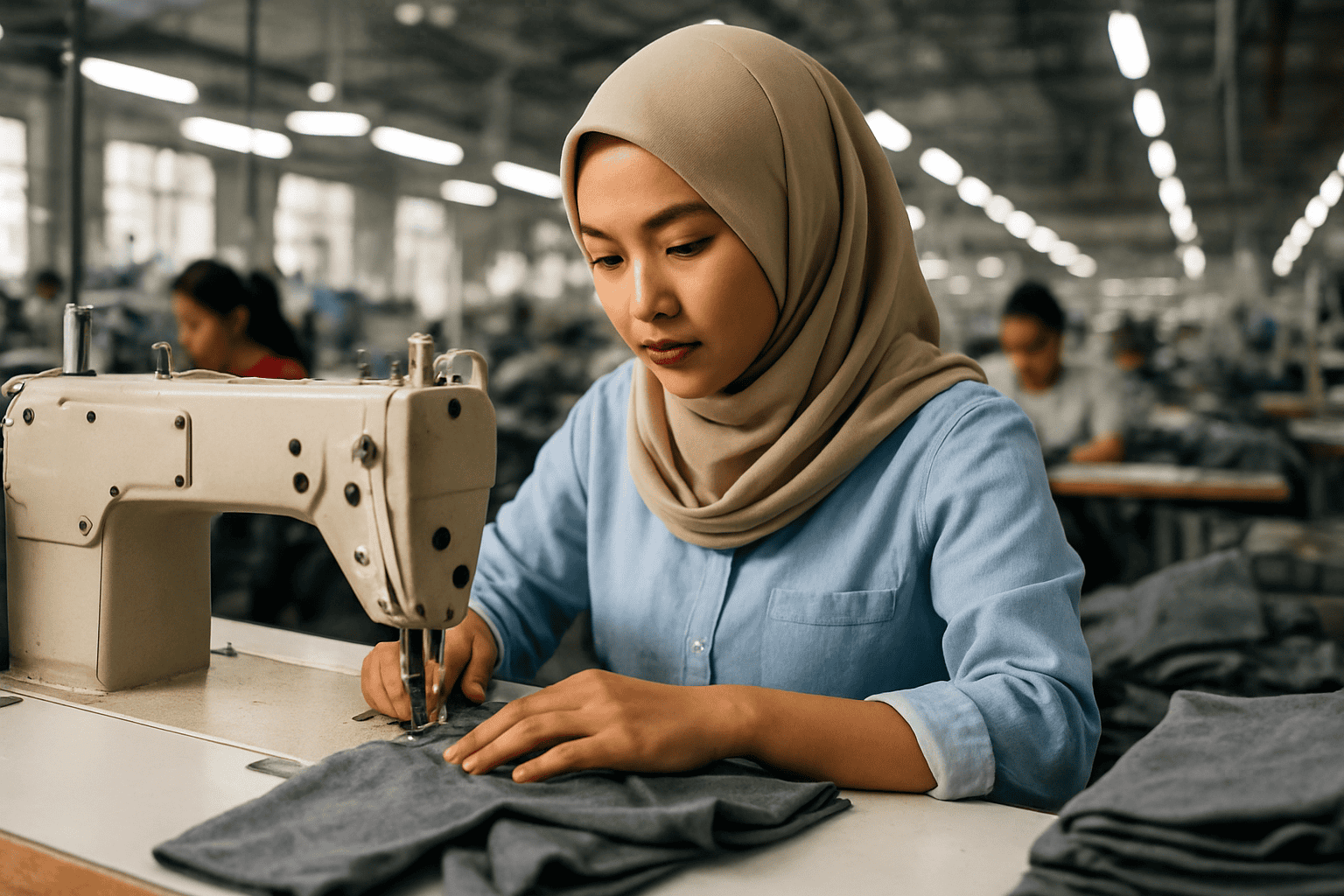
Private label is how a Singapore boutique stops reselling other people’s designs and starts selling its own: the label stitched at the back neck is yours, and the patterns sit on file under your programme’s name, ready to re-order. For a boutique brand in Singapore, the journey from tech pack to shelf runs through a Bandung factory in five stages, and the two festive windows that follow, Christmas stock on shelves by mid-November 2027 and Raya collections before Hari Raya on 10 March 2027, are the dates that schedule it.
What does private label mean for a boutique brand?
It means the garments are made to your specification, in your fabrics and colours, with your brand’s woven label at the back neck, and the patterns are yours to re-order from. It is different from buying white-label stock and relabelling it, and different again from commissioning a one-off custom piece; the differences matter commercially, and our page on private label versus white label versus custom sets them out line by line. What private label buys a boutique is an asset: patterns and blocks that improve with every season instead of resetting with every supplier.
What goes into a tech pack?
Less than most first-time brands fear, and more than a sketch. A workable tech pack carries flat sketches of each style, a measurement spec per size, a materials list, construction notes for the details that matter, and the labelling and packaging plan. It does not need to be beautiful; it needs to be unambiguous. A reference garment can stand in for several pages, and a brand that has its fabric direction chosen, shirting, poplin, twill, rayon or crepe for a woven programme, arrives ahead of most first packs. Where a pack is thin, the questions a factory asks back are how it gets filled, and the questions are the useful kind.
How does a tech pack become a pattern?
On the pattern table. Each style is drafted as a digital block, in our case on Lectra systems, and graded across the size curve the brand supplies. The block is the private label’s real body: it holds the fit decisions, it is stored with the programme, and every re-order comes off the same file, which is why a size medium ordered two seasons apart fits the same. This is also where the collar and placket choices live, decided once and reproduced exactly, rather than negotiated with a sample room every season.
What happens between approved sample and shelf?
Three stages, each with its own clock. Sampling takes one to two weeks per round, and the approved sample is the contract the bulk is checked against. Bulk production runs six to twelve weeks, cut from the held blocks and inspected against that sample before anything ships. Sea freight from Indonesia to Singapore adds, as a planning reference, one to one-and-a-half weeks door to door. End to end, a private label programme moves from approved sample to shelf in roughly seven and a half to thirteen and a half weeks, which is why the festive windows, not the factory, set the calendar.
Which window suits a first private label run?
The Christmas window is the classic entry: festive and summer wovens ordered between July and early August 2027, on the shelf by mid-November for the year-end season. The Raya window follows: collections ordered from December 2026 to mid-January 2027 for Hari Raya on 10 March 2027, and a boutique serving both builds a two-season rhythm on one set of blocks. Minimums shape the entry: the full-production floor starts at 1,000 pieces per style, and a first test of the label itself can run at 500 pieces per style through Kizen Lab’s pilot programme before the full run commits. Why two floors exist, our minimum-order page explains in full.
What can the boutique re-order from when the shipment lands?
The parts that compound. The patterns and blocks, held on file, which turn every future re-order into a reprint rather than a rebuild. The approved sample, which is the quality contract for every batch that follows. The fit history across the size curve, which is why season three fits better than season one. And the label itself, in the customer’s head, attached to garments that arrived on the shelf the week they were promised. Those assets are yours: every season adds to your own manufacturing memory, and our job is to keep it accurate. Where the whole calendar fits alongside the other three windows is on the group’s Singapore festive production calendar for 2027.
Private label questions
What is the difference between private label and white label?
White label is stock you relabel; private label is made to your specification, with your patterns, fabrics and branding, and the patterns remain yours to re-order from. The commercial differences are set out on our private label page above.
How many pieces does a first private label run need?
The full-production floor starts at 1,000 pieces per style, mixed across your size run. A label testing the water first can run 500 pieces per style on Kizen Lab’s pilot programme and graduate the design upward once sell-through justifies it.
How long does it take from tech pack to shelf?
From approved sample, six to twelve weeks of bulk plus a one to one-and-a-half-week freight leg to Singapore as a planning reference, with sampling rounds of one to two weeks before that. From a finished tech pack, most programmes land in two and a half to four months, sampling rounds included, so the festive window picks the order date.
What should a first tech pack contain?
Flat sketches per style, a measurement spec per size, a materials list, the construction notes that matter to the design, and the labelling plan. A reference garment can stand in for several pages; ambiguity is the only real enemy of a first pack.
The tech pack can start life as a sketch; either way, the journey from pack to shelf is quoted stage by stage on the consultation page.