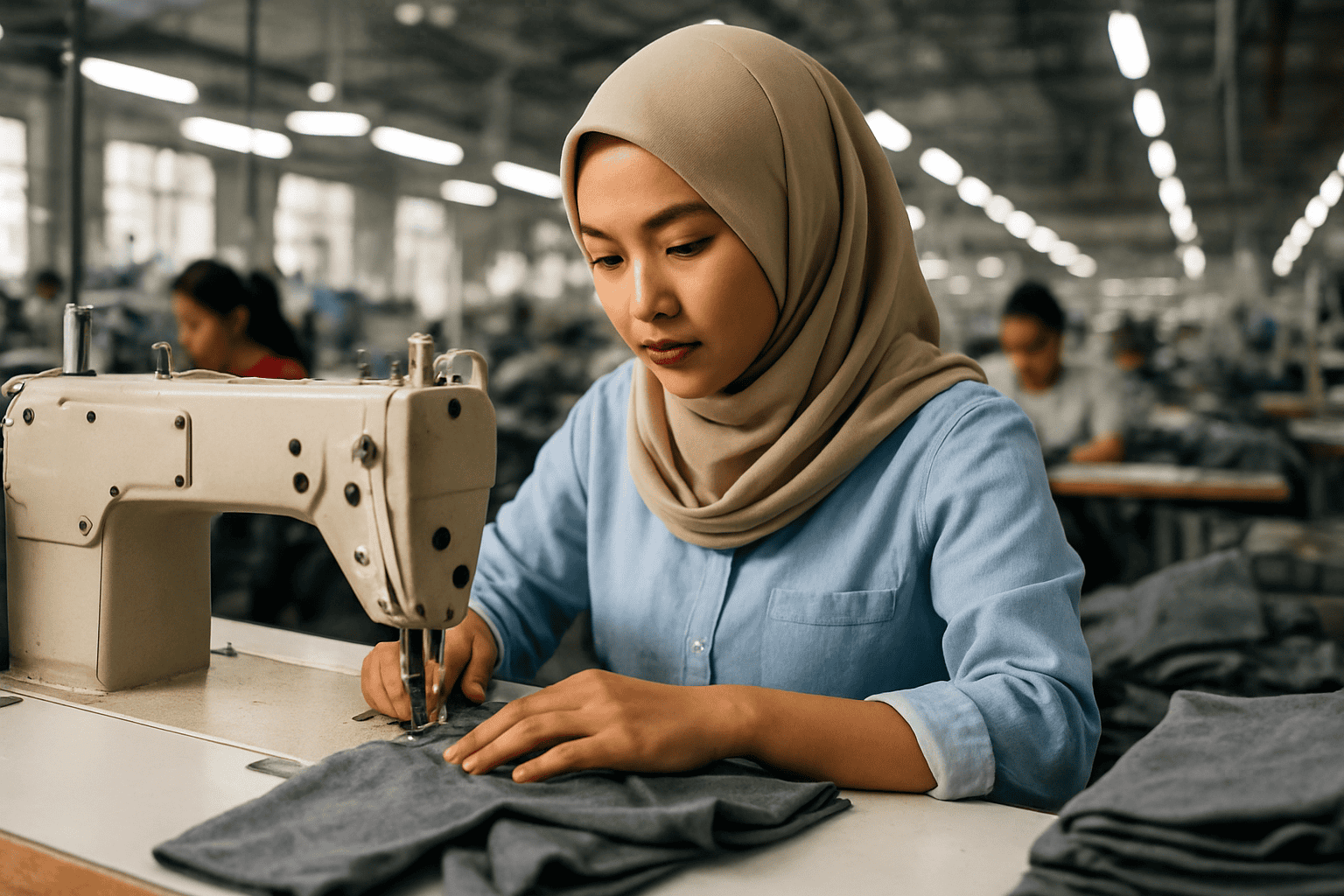
When brands look for leading garment manufacturers, the conversation is no longer just about price. Anyone can quote low. The real question is whether the clothing production factory can handle pressure, scale properly, and keep quality consistent when volumes increase. They are trying to solve operational risk.
Can this clothing production factory handle 20,000 pieces without quality dropping after the first 2,000?
Can they manage fabric delays without collapsing the whole timeline?
Do they understand export standards, or are you going to be fixing problems every shipment?
Those are the real question.
Over the past decade, sourcing has shifted. China is still dominant, Vietnam is strong, Bangladesh competes aggressively on cost. But more brands are adding a garment manufacturer Indonesia to their supplier mix, especially those producing structured woven garments and mid to high value apparel.
What Actually Makes a Manufacturer “Leading”
The term leading garment manufacturers gets used loosely. In reality, most factories are average. A small percentage operate at a level that serious brands rely on long term.
A factory becomes “leading” when it can do the following consistently:
• Maintain stable production capacity month after month
• Control quality across multiple lines
• Deliver on schedule, not occasionally, but predictably
• Manage fabric procurement professionally
• Communicate clearly with overseas buyers
• Survive market downturns without shutting lines
A clothing production factory that cannot survive fluctuation is not leading. It is fragile. Serious brands look beyond unit price. They look at systems.
Why Indonesia Is Getting More Attention As One of the Leading Garment Manufacturers
Indonesia has been producing garments for global markets for decades. This is not a new industry there. The difference now is that more mid sized and established brands are actively looking at it, not just large multinational buyers.
There are a few reasons.
First, cost pressure in China has changed sourcing calculations. Labour, compliance, and operating expenses have all increased significantly. For some product categories, the numbers no longer make sense.
Second, brands want diversification. Relying on one country creates risk. Trade policy shifts, tariffs, port congestion, currency movement, all of these factors affect margin.
Adding a garment manufacturer Indonesia based supplier reduces concentration risk without sacrificing capability.
Production Capability in Indonesia
Indonesia is particularly strong in woven garment production. Structured shirts, tailored trousers, jackets, workwear, dresses, uniforms. These categories require tighter control compared to basic knit items.
A serious clothing production factory in Indonesia typically includes:
• In house cutting
• Multiple sewing lines
• Dedicated sampling team
• Inline and final QC teams
• Pressing and finishing department
• Export packing team
Factories range from 500 workers to well over 2,000 workers depending on size. Capacity is real. This is not small workshop production pretending to be industrial scale.
For brands producing 10,000 to 100,000 pieces per month, Indonesia has factories built to support that level.
Labour and Skill Level
Skill level matters more than most brands admit.
A pattern mistake or poor line balancing will quietly destroy margin. Rework, delays, air freight to save missed deadlines, all of it adds up.
Indonesia has a deep sewing workforce. Many operators have long tenure. Supervisors and line leaders are experienced in export production. Pattern makers understand grading and fit adjustments for international markets.
That does not mean every factory is perfect. It means the talent pool exists, and strong garment manufacturer Indonesia operations invest in retaining skilled workers.
Cost Structure, Beyond the Unit Price
Indonesia is not the absolute cheapest country in Asia. If you are producing extremely basic, high volume, low margin garments, other countries may quote lower.
But cost must be evaluated correctly.
You need to consider:
• Reject percentage
• Rework rate
• Fabric wastage
• Delay penalties
• Air freight recovery costs
• Communication inefficiencies
A slightly higher FOB price from a stable clothing production factory can result in lower overall cost per sellable unit.
Leading garment manufacturers understand efficiency, not just pricing.
Quality Control Systems
Quality is not a slogan. It is a structure.
A serious factory in Indonesia will have:
• Inline QC checking each bundle
• End of line inspection
• Measurement audits
• Final random inspection before packing
• Fabric inspection before cutting
If a factory only checks quality at the end, it is already too late.
When evaluating a garment manufacturer Indonesia partner, ask about their QC ratio. How many QC staff per line? How do they record defects? Do they track recurring issues?
Factories that measure performance improve. Factories that do not measure guess.
Compliance and Buyer Requirements
Brands selling into Australia, Europe, and the US cannot ignore compliance.
Social standards, fire safety, wage documentation, working hours, environmental practices. These are part of the sourcing decision.
Indonesia has many factories that operate under international compliance frameworks. Larger clothing production factory operations are familiar with audits and buyer inspections.
If your brand requires formal certification, it is available in the market. You just need to choose carefully.
Infrastructure and Logistics
Indonesia’s main industrial zones are connected to major ports, particularly around Jakarta.
Export documentation is mature. Freight forwarders are experienced with garment shipments. Shipping times to Australia, Europe, and the US are competitive within Southeast Asia.
For Australian brands specifically, Indonesia offers geographic advantage compared to some other manufacturing countries. Transit times are manageable, and communication time zones are workable.
Logistics is not perfect anywhere. But Indonesia is not an emerging experiment. It is an established export environment.
Communication and Management Structure
One of the biggest hidden costs in sourcing is miscommunication.
Incorrect tech pack interpretation. Unclear fabric specification. Sample revisions not tracked properly. Production assumptions not confirmed.
Leading garment manufacturers invest in management teams who can communicate clearly in English and understand buyer expectations.
When a clothing production factory responds quickly, confirms details clearly, and flags potential issues early, it saves weeks of friction.
This is often underestimated by brands who focus only on price negotiation.
Minimum Order Quantities and Scale
Indonesia is well suited for medium to large brands.
Most serious factories operate with realistic MOQs because production lines must be efficient. Very small orders disrupt flow and increase cost.
If your brand is ordering 1,000 pieces per style or more, a garment manufacturer Indonesia partner can structure production efficiently.
If you are testing with 100 pieces, you may struggle to find the right fit.
Leading garment manufacturers prefer stable reorder clients who understand production rhythm.
Risk Management in a Changing Global Market
Global sourcing is no longer static.
Tariffs shift. Exchange rates fluctuate. Political relationships evolve. Freight costs spike unexpectedly.
Brands that rely entirely on one country are exposed.
Adding Indonesia into the supplier mix provides diversification without sacrificing production capability.
A garment manufacturer Indonesia based partner can act as a secondary production base or a primary base depending on product category.
This flexibility has become strategically important.
Product Development Support
Strong factories do more than follow instructions.
They assist with:
• Pattern correction
• Fit improvement
• Construction optimisation
• Cost engineering
• Fabric alternatives
A capable clothing production factory becomes part of your technical team.
This is where long term relationships matter. Factories invest more effort when they see stable business.

How to Evaluate Leading Garment Manufacturers in Indonesia

If you are serious about sourcing, evaluate properly.
Visit if possible.
Walk the production floor.
Check how lines are organised.
Observe operator density.
Look at finishing quality.
Review sample room capability.
Ask about monthly capacity. Ask about peak season performance. Ask about their biggest production challenges in the last year.
A transparent factory will answer clearly.
Marketing language is easy. Operational clarity is harder.
Why Indonesia Is Positioned for Long Term Growth
Indonesia combines scale, skill, export experience, and relative cost competitiveness. It is not trying to be the cheapest in Asia. It is competing on capability and reliability.
As more brands reassess sourcing strategy, the country continues to gain attention among leading garment manufacturers globally.
For brands that require structured woven garments, medium to high volume production, and stable export systems, working with a clothing production factory in Indonesia is not an experimental move. It is a strategic one.
If your brand is scaling and needs a garment manufacturer Indonesia partner that can handle serious production without constant firefighting, the opportunity is there.
The real question is not whether Indonesia can produce. It is whether you are choosing your factory with a long term operational mindset instead of chasing short term pricing.
That decision will determine more than just your unit cost.
If you would like to work with us, contact us here.